Astra Assessments
The Astra Cycle
Here is what happens between the day a district selects standards and the day teachers open their reports.
From scope and sequence to standard-level mastery in six steps.
Districts select standards
At the start of each quarter, a district's assessment lead selects up to four standards per grade in ELA and up to four in Math—the specific standards students are being taught that quarter. Astra does not assume what you are teaching—it asks.
Aligned items
Astra assembles a quarterly assessment of roughly 20 items, calibrated to the standards you selected and varying in complexity so students at different ability levels are measured with equal precision.
Quarterly assessments
Delivered within a common assessment window, each assessment is designed to be completed in a single class period. It is short by design—Astra is meant to inform instruction, not consume it.
Bayesian calibration
Responses are scored using a two-stage Bayesian Structural Equation Modeling architecture: item calibration in stage one, higher-order aggregation in stage two.
Detailed reports, fast
Teachers receive standard-by-standard score reports along with the items and student responses within days of the assessment window closing.
KAP prediction accrues
As quarterly data accumulates across the year, Astra produces a composite score that predicts end-of-year KAP performance with published R² values of 0.70–0.90 in pilot data.
The Assessments
Four quarters. Two subjects. Standards you choose.
Astra delivers four quarterly benchmark assessments across two subjects. For each quarter, districts select up to four standards per grade in each subject—the specific standards being taught—and, in ELA, the topical area for the quarter's reading passage. Every assessment is built around district input—nothing is prescribed by a national item bank.
Mathematics
Grades 2–8, plus Algebra I, Algebra II, and Geometry.
Districts pick up to four standards for the quarter. Astra assembles a 20-item assessment—five items per standard—calibrated to those exact standards and varying in complexity so students at different ability levels are measured with equal precision.
English Language Arts
Grades 2 through high school.
Districts pick up to four standards plus the topical area for the quarter's reading passage. Astra assembles 20 items—five per standard—all grounded in one shared, curriculum-relevant reading passage that anchors the entire assessment.
Powered by

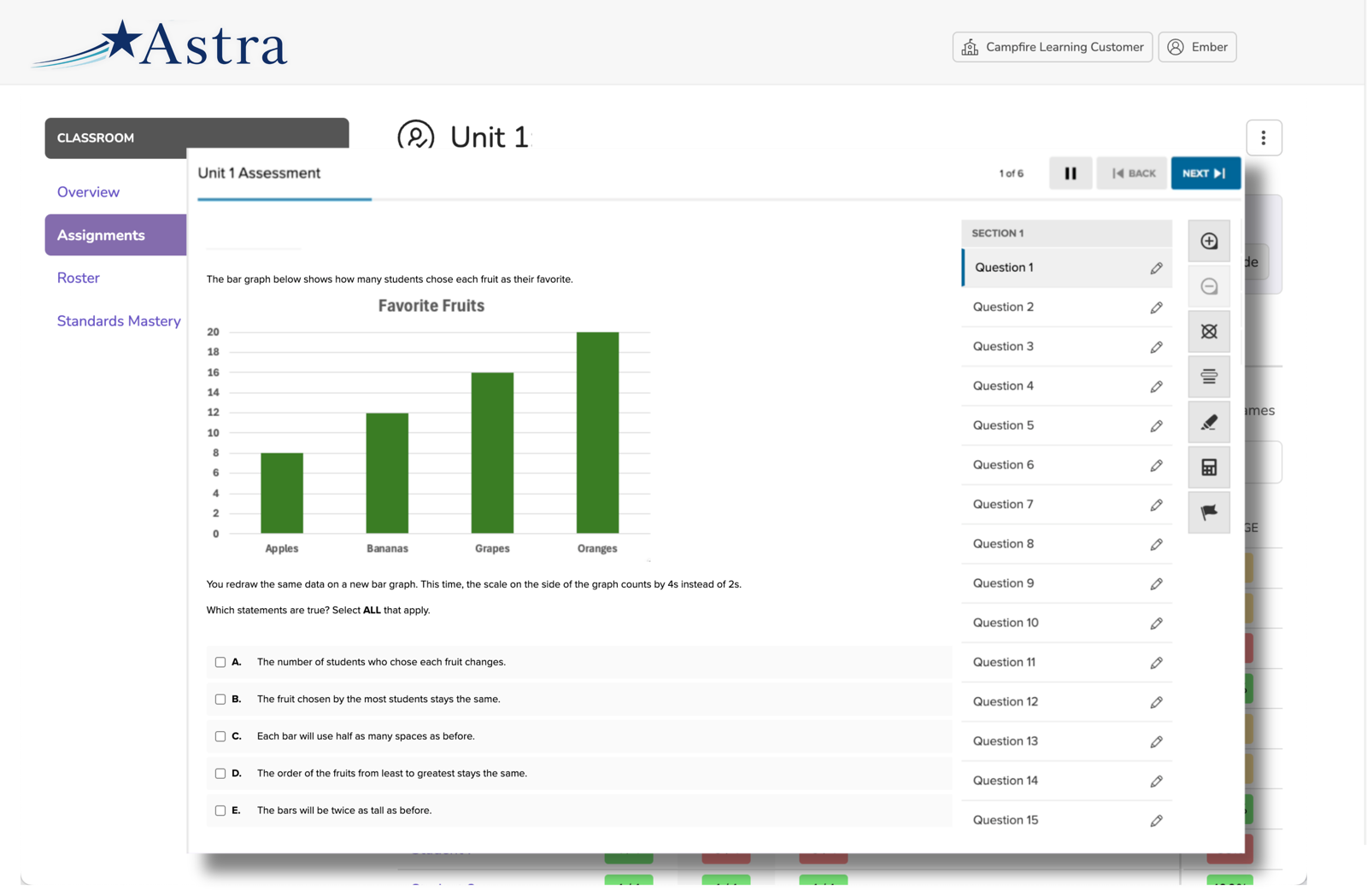
Every Astra assessment is built and delivered on Campfire, the technology engine behind the experience from start to finish.
Assessments are authored in Campfire Studio, a collaborative authoring platform that supports 30+ item types and makes standards-aligned content development fast and flexible.
From there, Campfire Classroom brings it to life for students—a full assessment platform built for effortless access and a smooth testing experience. Secure and accessible by design, it integrates seamlessly with district SSO and rostering systems for painless setup, and gives educators real-time performance data for clear, immediate insight into student progress.
What Teachers See
Standard-level results, not a single composite score.
Composite scores at the subject level tell a teacher that a class is above or below proficient. They do not tell that teacher which standard the class missed, which standard the class is strong on, or which standard needs reteaching next week. Astra reports resolve those questions at the level teachers actually plan instruction around—for each of the standards the district selected that quarter.
Each report shows every standard assessed that quarter, the items and item responses of each student, and an overall prediction of how students will perform on the KAP assessment at the end of the year. Teachers are not asked to interpret psychometric jargon—the report speaks in the same units teachers use to teach.
What Administrators See
KAP prediction that stays honest across the year.
For principals and superintendents, Astra rolls up quarterly data into a KAP-predictive composite that updates each quarter as new evidence arrives. Because the composite is grounded in items aligned to the standards Kansas actually assesses on KAP, the prediction is stronger than what generic national benchmark products can produce.
In Their Own Words
What Kansas superintendents are saying.
The data from the assessment allows our staff to anchor their conversations on what's next.
Great Bend Public Schools has just wrapped up our first year partnering with IAS using through-year assessments (quarterly proficiency screeners) in grades 3–HS in both ELA and Math including Algebra I, Geometry, and Algebra II. It has been so successful that second grade teachers approached the district seeking to implement them starting in 2026–2027. When teachers seek out the addition of quarterly assessments, you know something good is happening!
When we receive our scores back, they come with a step-by-step process for our teams to use when reviewing that data. It's not just a one-look and done. There's a huge focus on how that will impact our instruction moving forward with our class, what an individual student might need, and how we might adjust our instruction the next time we teach those concepts. The built-in piece that we don't talk about a lot is the power of our teachers getting to see the questions, hearing how they are worded, and asking themselves if instruction was provided at that depth of learning. In several cases, that depth is included in our materials, but it's one of the pieces that gets left out when time runs short. This assessment and its focus on professional learning are helping us become better users of our high-quality instructional materials.
On the Record
Presentations to Kansas policymakers.
Kansas State Board of Education—IADA pilot update from Dr. Zach Conrad (August 11, 2026)
Dr. Zach Conrad, Deputy Commissioner of Accountability and Technology for the Kansas State Department of Education, provides an update to the Kansas State Board of Education on the IADA (Innovative Assessment Demonstration Authority) pilot—the federal pilot under which Astra is used. The embed below is cued to his update.
Segment runs from 1:27:32 to 2:05:00. Watch on YouTube.
Kansas State Board of Education—Olathe & IAS presentation (February 11, 2026)
Olathe USD 233 and IAS present on the Astra implementation. The embed below starts at the Olathe & IAS portion of the meeting (about 50 minutes of substantive content). Fair warning: this is depth-of-detail material for board members and district leaders reviewing the program.
Dr. Amber Wheeler on Astra
In this ~1 minute segment, Dr. Amber Wheeler, Superintendent of Humboldt USD 258, speaks in support of the Astra program.
Excerpt runs from 41:47 to 42:55. Watch on YouTube.
Kansas House Committee on K-12 Education Budget—Conrad & Templin testimony (March 4, 2026)
Dr. Zach Conrad (then of Kansas City Kansas Public Schools) and Dr. Jonathan Templin, IAS co-founder, testify to the Kansas House Committee on K-12 Education Budget. About 70 minutes total, delivered in two parts with Q&A.
In this segment
- 1:02—Dr. Zach Conrad opens with the program's history and district context (then at KCKPS)
- 30:22—End of Dr. Conrad's Q&A
- 32:00—Dr. Jonathan Templin begins on the modeling and technical side of the project
- 1:11:41—End of Dr. Templin's Q&A and the presentation segment
Click any timestamp to open the full committee hearing on YouTube in a new tab.
Federal Approval
Approved by the U.S. Department of Education.
On July 31, 2026, the Kansas State Department of Education announced that the U.S. Department of Education approved Kansas to pilot a through-year assessment system under the Innovative Assessment Demonstration Authority (IADA)—the only federal pathway for a state to use an innovative assessment in place of its standard summative test for accountability. According to KSDE, Kansas is one of only seven states approved for IADA since the program began in 2018; per the USDoE IADA page, Kansas is also one of only two states approved in the past five years, alongside Missouri (approved July 31, 2025). The assessment KSDE is deploying is built by Innovative Assessment Solutions and marketed as Astra.
Read the KSDE announcement →
View Kansas's IADA application and materials on ed.gov →